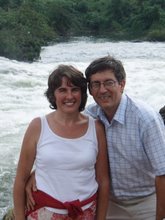
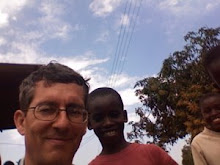
In three days it will be 4 years since we landed on Uganda soil and we landed back on UK soil 8 months ago. It would be an interesting study to see how people are affected by their time in Africa. This is my first public analysis of my own case.
There are at least two life-styles to chose between for ex-pats in Uganda: 'ex-pat', and 'integrated'. For ex-pats in good jobs the former means living at or above the lifestyle of the home-country, with the added benfits of the huge difference in buying power in a Developing country. So ... a huge walled-in house in a nice part of town, servants quarters, security guard, membership of a good club, kids at expensive private (predominantly) ex-pat schools, a large 4x4, lots of meals out, and almost all of one's time spent in the company of other ex-pats. Those involved in mission as volunteers or on low incomes easily get sucked into this life but because they don't have the income to sustain it they increasingly look to their supporters for help, without necessarily challenging themselves why, leading to tensions.
The latter, an integrated lifestyle, is one where most of one's friends are locals and thus most of one's time is spent with them. One becomes embroiled in the details and challenges not of other mzungus (foreigners) but of ordinary local Ugandans. The challenge of this lifestyle-choice is that mzungus are assumed by all but the most educated Ugandans to be so incredibly wealthy that they believe our pockets are bottomless. This leads to a daily tension between taking an interest in people and having to build a strong line of defence against being sucked daily into huge unsustainable financial demands.
We felt we should live the latter way. But in fact employing a local person in the home creates a job that can help support an entire family for around £30-£50/month. So nothing is quite as black and white as I set out above. Our total income in the latter two years was around £1250/month with the support element from friends averaging £550/month of this. A teacher in Uganda earns about £150/month if they are lucky but we saw many paid only £50/month or some as low as £25/month; a Ugandan will pay a houseboy/girl around £15/month plus free accommodation and daily food. Boarding school fees are around £80/term/child average; most employed Ugandan parents send their kids to a boarding school because it is cheaper after the transport and food are taken into account than if they were day students.
This gives some financial context. (One can see how tight life is for Ugandans with several children at school!!)
Now for expenditure. Many Ugandans eat only one meat meal a month, albeit in the Lake Victoria area fish may be eaten several times a month. People in our area live off maize flour mixed with water ('posho'), sweet potato, cassava, and other vegetables – with beans providing the main source of protein. Elsewhere g-nut (peanut) becomes the main protein source. They drink a lot of tea. Most Ugandans live off their land, and this may often have become very small through generations of division to successive family members. So around the heavily populated areas average land holdings can be 2-3 acres and it will be worked by the (unpaid) family members, often children whose fathers may resist sending them to school (especially girls who do most of the work!). Its hard to live off such a small patch of land especially with the appalling lack of good seed and poor farming knowledge in most cases.
By the time we left we were heavily involved in the care and financing of about 8 children or families, and hosting a weekly Bible-study/fellowship meeting in our home of about 15 local 17-25 year-olds. I was also managing 18 small business loans that I had arranged and this meant a lot of time and energy in coaching and mentoring people as well as coaxing them to pay up! I had helped set up a small NGO in Karamoja and this was beginning to unravel badly. Then 5 days before leaving I had my essential laptop, camera, records, etc., stolen from my side in the car, including £2,500 on its way to being changed into £GB from Uganda schillings to help us settle into the UK. Then a church leader 'ran off' with another £2,000 loan we made earlier to him and were expecting back.
So we left in a rather stressful climate!
For the first 6 months after returning I felt physically sick every time I thought about Uganda. It was not that I had lost my love for our friends, or failed to feel compassion for the nation, but rather that I felt such a conflict of emotions that my stomach knotted up. Because we were SO involved with so many people in Uganda I suppose it feels like my heart has been wrenched out of position! Over the last two months this feeling has changed to 'detachment'. Now I feel a long way from any community! Living as guests in others homes is a humbling and wonderful privilege but doesn't engender a true sense of 'being rooted'.
After being able to make such a huge difference in people's lives and be involved in transformational activity in Uganda and elsewhere in E Africa, the lifestyle of Welsh self-build and now unemployment – and feeling somewhat 'superfluous' in a very able and high-achieving nation – has left me drained and feeling it was all an unreal dream. Its as if there are parallel universes and I have lived in both ........ and neither!
The thing that has been constant throughout is the love of friends. And the sense of God's presence with us – mostly through the Christian fellowship in practical ways that is the chief evidence of God's transforming love. God reveals Himself through people's changed lives, I realise.
Normality! What is this elusive thing? We have yet to find it. What is clear is that the West has lost the sense of extended family and community ('together-givers', from the Greek) and the Church is the sole vehicle for some sense of this in many places back here. Our search for individual expression is myopic and empty. It leads to a lonely dead end. OK, it may be simpler but rich living comes from interaction and interdependence, not independence.
Friday, December 3, 2010


Tuesday, November 16, 2010
An extract about 'The Local Church' by Dr. Campbell Morgan
Someone shared this extract with me the other day. What a terrific piece of writing, packed with undeniable truth for our day ....and every age!
“The Church of Christ – take a local Church as indicating the great and ideal application – a local Church, so at the disposal of the Spirit as the Spirit through the Church can flash and flame upon the outside world, so as to amaze, perplex, and raise an enquiry; a local Church, one within its borders in fellowship with Christ, and testifying to Christ invariably a Church in favour with the people. Not that we should seek the patronage of the multitude, but that we are so to reveal Christ as to be centres of attraction to the multitude. The moment we depart from Him, we lose the crowd. The Church of Christ, where the Christ Himself is the supreme revelation made – not only through the individual lives of its members, but in its corporate capacity – where the compassion of Christ and the life of Christ are manifest in the mutual inter-relationship of the souls forming the Christian Church, as to the Church to which the weary and woebegone will turn. That is the true influential Church. How we have degraded that word ‘influential’. We call a Church ‘influential’ now because of the kind of people that attend it, because of the money it raises for philanthropic objects. There was a Church in the olden days that said, “I am rich, and have gotten riches, and have need of nothing,” and the Master, walking amid the golden candlesticks said: “Thou ……. knowest not that thou art the wretched one and miserable and poor and blind and naked.” So He would say to day to many Churches which we describe as ‘influential’. The influential Church id the company of loyal souls who “continue steadfastly in the apostles’ teaching and fellowship, and in the breaking of bread and the prayers,” who eat their meat with gladness and singleness of heart, who manifest in their individual lives and corporate capacity the strength, the beauty, the glory, the compassion of Christ. Wherever there is such a Church you will find the Church has favour with the people”.
“The Church of Christ – take a local Church as indicating the great and ideal application – a local Church, so at the disposal of the Spirit as the Spirit through the Church can flash and flame upon the outside world, so as to amaze, perplex, and raise an enquiry; a local Church, one within its borders in fellowship with Christ, and testifying to Christ invariably a Church in favour with the people. Not that we should seek the patronage of the multitude, but that we are so to reveal Christ as to be centres of attraction to the multitude. The moment we depart from Him, we lose the crowd. The Church of Christ, where the Christ Himself is the supreme revelation made – not only through the individual lives of its members, but in its corporate capacity – where the compassion of Christ and the life of Christ are manifest in the mutual inter-relationship of the souls forming the Christian Church, as to the Church to which the weary and woebegone will turn. That is the true influential Church. How we have degraded that word ‘influential’. We call a Church ‘influential’ now because of the kind of people that attend it, because of the money it raises for philanthropic objects. There was a Church in the olden days that said, “I am rich, and have gotten riches, and have need of nothing,” and the Master, walking amid the golden candlesticks said: “Thou ……. knowest not that thou art the wretched one and miserable and poor and blind and naked.” So He would say to day to many Churches which we describe as ‘influential’. The influential Church id the company of loyal souls who “continue steadfastly in the apostles’ teaching and fellowship, and in the breaking of bread and the prayers,” who eat their meat with gladness and singleness of heart, who manifest in their individual lives and corporate capacity the strength, the beauty, the glory, the compassion of Christ. Wherever there is such a Church you will find the Church has favour with the people”.
Friday, November 12, 2010
Latest news: back in ol' blighty
As noted, I am back in the UK, and we spent from May to mid-October at our 'estate' in Ystradfellte, Wales. I was working flat out self-building alongside two wonderful local stonemasons, Paul & Gavin, whilst Sandy was in the caravan earning money with her copy-editing.

The aim was to get the other two barns ('2' & '3') watertight and stable. The walls were already falling over and very unstable when we bought them in 2005, and the last winter had caused significant further damage. In addition they weren't up to the roof profile in any section so a huge amount of rebuilding and repair was required. Not only did we do all this within the budget but 3 weeks ahead of schedule, despite a lot of rain interruptions.
Now the slate roofs are on all the properties, and the walls are finished, apart from a glazed screen to be constructed a spart of the final 'link' element with a grass flat roof, that will tie the whole suite together.
In the last few days I started to open up the floors to establish the slab levels, and discovered the original 17th century floor. This has now for to be recorded and drawn accurately for the archives CADW archives, which is another chore, but quite fun.
Indy, our lovely dog, was reunited with us and loved the life up in the hills! Great walks each day with lots of interesting smells. It was a glorious time in our lives; Red Kites soared above each day along with Buzzards and Great Spotted Woodpeckers, Nuthatches, Redstarts, and Tree Creepers feeding around us. We had two healthy-looking foxes run through, followed minuted later by the local hunt!

Best of all was getting embedded back into local village life: rebuilding links with those we already knew and making new ones. The locals are so incredibly friendly and kind. London seems a million miles away with its rushing, self-absorbed inhabitants! It was so good to have the kids, grandkids and dear friends visit us and share in the excitement of getting the barns finished.
Now we are down in our old haunts of Lewisham. Our dear friends, the Plummers, offered us a share of their home for 6 months, and have been so amazingly generous and kind to us – even accepting a dog into their home for the first time ever!! True friendship! The plan was for me to get the normal consukltancy work in RSL's for 6 months and then, with the dosh earnt, we would move back to Llwyn Onn in May, do some more work, and get into the barns permanently. The work climate is so bad that this is proving a very ambitious plan and today I am still unemployed with funds running very low! So I am applying to a range of full time posts, some of which are very exciting. We may just have to put the barns on ice and spend the money on the barns from a distance as it appears!!
Hmmmm. Sometimes God appears decidedly not aligned with our plans and one has to recognise that He is not there to underwrite our lives but rather to be the greatest friend through the challenges. Life without Him is empty and bland, and being successful is nothing without Him either. So its scratching head time and I'm ruminating and cogitating like a blinking cow! Onwards and upwards!!
Sandy smiles through it all and keeps her head down on the page!

The aim was to get the other two barns ('2' & '3') watertight and stable. The walls were already falling over and very unstable when we bought them in 2005, and the last winter had caused significant further damage. In addition they weren't up to the roof profile in any section so a huge amount of rebuilding and repair was required. Not only did we do all this within the budget but 3 weeks ahead of schedule, despite a lot of rain interruptions.
Now the slate roofs are on all the
 properties, and the walls are finished, apart from a glazed screen to be constructed a spart of the final 'link' element with a grass flat roof, that will tie the whole suite together.
In the last few days I started to open up the floors to establish the slab levels, and discovered the original 17th century floor. This has now for to be recorded and drawn accurately for the archives CADW archives, which is another chore, but quite fun.
Indy, our lovely dog, was reunited with us and loved the life up in the hills! Great walks each day with lots of interesting smells. It was a glorious time in our lives; Red Kites soared above each day along with Buzzards and Great Spotted Woodpeckers, Nuthatches, Redstarts, and Tree Creepers feeding around us. We had two healthy-looking foxes run through, followed minuted later by the local hunt!

Best of all was getting embedded back into local village life: rebuilding links with those we already knew and making new ones. The locals are so incredibly friendly and kind. London seems a million miles away with its rushing, self-absorbed inhabitants! It was so good to have the kids, grandkids and dear friends visit us and share in the excitement of getting the barns finished.
Now we are down in our old haunts of Lewisham. Our dear friends, the Plummers, offered us a share of their home for 6 months, and have been so amazingly generous and kind to us – even accepting a dog into their home for the first time ever!! True friendship! The plan was for me to get the normal consukltancy work in RSL's for 6 months and then, with the dosh earnt, we would move back to Llwyn Onn in May, do some more work, and get into the barns permanently. The work climate is so bad that this is proving a very ambitious plan and today I am still unemployed with funds running very low! So I am applying to a range of full time posts, some of which are very exciting. We may just have to put the barns on ice and spend the money on the barns from a distance as it appears!!
Hmmmm. Sometimes God appears decidedly not aligned with our plans and one has to recognise that He is not there to underwrite our lives but rather to be the greatest friend through the challenges. Life without Him is empty and bland, and being successful is nothing without Him either. So its scratching head time and I'm ruminating and cogitating like a blinking cow! Onwards and upwards!!
Sandy smiles through it all and keeps her head down on the page!
Saturday, May 8, 2010
We're back in UK, and the place we live can be viewed at:
http://maps.google.co.uk/maps?f=q&source=s_q&hl=en&geocode=&q=CF44+9JD&sll=53.800651,-4.064941&sspn=18.703427,38.276367&ie=UTF8&hq=&hnear=Aberdare,+Mid+Glamorgan+CF44+9JD,+United+Kingdom&ll=51.814051,-3.539427&spn=0.002381,0.004672&t=h&z=18
I am self-building a restoration/conversion of three 18th century stone barns into a home for Sandy and I in one of the most beautiful valleys in the UK, the Mellte Valley, Brecon Becon National Park.
http://maps.google.co.uk/maps?f=q&source=s_q&hl=en&geocode=&q=CF44+9JD&sll=53.800651,-4.064941&sspn=18.703427,38.276367&ie=UTF8&hq=&hnear=Aberdare,+Mid+Glamorgan+CF44+9JD,+United+Kingdom&ll=51.814051,-3.539427&spn=0.002381,0.004672&t=h&z=18
I am self-building a restoration/conversion of three 18th century stone barns into a home for Sandy and I in one of the most beautiful valleys in the UK, the Mellte Valley, Brecon Becon National Park.
Friday, February 26, 2010
The Ugandan borda borda (or bodaboda)

The borda-borda[1] – feared and detested throughout Uganda but the only transport system able to deliver economical and reliable short-distance door-to-door service – it brings shudders from tourist and Ugandan housewife alike. Responsible for 50% of all deaths on the road, and in most people’s mind causing all the rest and endless road-rage, it is a curse to which the majority are reluctantly resigned.
What is the borda-borda - “What sort of name is that?” most mzungus (foreigners) cry. It is the two-wheeled taxi service, the moped or small motorbike that darts and weaves the road, running the gauntlet of every gap - emerging and disappearing - in the Kampala traffic. It is the life-blood of the Ugandan road system, with thousands of them pouring through the city’s arteries like red blood cells in a particularly disturbing internal body-camera scene from ‘House’. It is the mystery of the universe - how do they do it?! It’s the only way to get from the main road to ‘the village’ or from where you are to ‘not-too-far-away’. It is the platform that screams its defiance to the idea that a moped is designed for two.
The most satisfying myth of the name’s derivation is from the Uganda/Kenyan border. Pedestrians could at one time only cross the no-go zone of some several hundred yards on official mopeds, and thus they were called ‘border to borders’. When these mopeds became available on the open market, the name stuck. Its sound and immediate associations place it in the same genre as ‘barracuda’, ‘kamikaze’, ‘hari-kari’, abracadabra, ‘out of order’, and ‘going under’.
Who travels on a borda-borda? It is a regular sight to see a 100+kg sow, alive but trussed up like some sort of fiendish bondage fetish, balanced precariously across the seat. The other day I saw an 85kg Nile Perch the size of a stout gentleman wiggling frantically, wanting to get off. It could be a ladder, albeit swung at an angle across the back seat to reduce the risk of amputation at the hip to passing pedestrians. Or a man holding in front of him a huge sheet of glass, screaming at the driver in front as the glass bends inexorably in the wind to the point of destruction. Or a family of mother, father and three children, including babe in arms (actually balanced over the petrol tank in front of the driver; the driver looks down occasionally to make her smile and wave at him). Or a set of poles on which are slung, legs tied together and hooked over, 24 or more hens, alive but looking concerned at the loss of feather composure. Or a three-seater settee. Or four stacked crates of Nile beer bottles. Or a set of four 20’ long eucalyptus poles being dragged behind along the road. There is nothing I can see now that will cause me shock, albeit maybe some laughter.
They are the subject of most tourists’ conversation within the opening days of the safari holiday, and the consensus is that these are brain-dead imbeciles, incapable of understanding the word ‘line’ let alone driving along one. For those who risk (for there is little option) the ride – or should I say ‘thrill’ – you get the impression that the driver’s eye-hand co-ordination says more about his libido than his driving skills as he stares at the gorgeous girls in passing cars. For those who get as far as the ride along a terrifying murram village track deep into the country, weaving like a rabid dog on amphetamines between holes in which a car could be lost and rain-filled ravines of uncertain depth, there is now the absolute certainty that a frontal lobotomy is a pre-requisite qualification for drivers.
So …… when I set out on my brand new ‘Max 100R TVS’ (2.3m USh - £770 - including helmet, insurance and road tax) from our house at the very end of one of these tracks to the Entebbe Road, 2 km away, my mind was focussed on how I, as an expert middle-aged English motorcyclist, would put these guys to shame. This typical borda-borda 100cc moped, dressed up to look like a whizzy motorbike, is less than 10% of the engine capacity of my drop dead gorgeous BMW R1100RT that I sold to pay for my air ticket out here. It is so light that I can almost tuck it under my arm and carry it. The tyres were thin enough to have come off a BMX bike.
I failed to notice along my track the glossy path formed by the hundreds of borda-bordas tyres over the days through the constantly shifting sea of mud and treacherous shoals of murram. (Follow that to salvation, like finding Theseus’s thread through the maze.) I failed to register that my endless starting and stopping to tackle the accelerating bumps and craters was straining the engine, shredding my nerves, and making the bike lurch manically as it lost momentum and direction.
I was vaguely conscious (through a rising red mist) that borda-bordas were bombing past me laden with women sitting side-saddle, serenely smartening their make up or chatting to another alongside. It seemed impossible! I, I was the master, not them! Kids were laughing in disbelief “Mzungu, mzungu, bye-ee mzungu!! I accelerated, intent on regaining the lead. The road’s surface suddenly became a caricature of what we would in the UK call ‘a camber’, but with a razor sharp central ridge and slopes each side of Alpine proportions. Across it appeared a road hump so high that Evil Knievel would have been happy to use one to leap the Grand Canyon. In that moment of sheer terror I broke the first rule of my training 20 years earlier and yanked the front brake. A split second later I was sliding along the murram gravel on my forearm, aware vaguely that the subcutaneous tissue was absorbing most of the track.
Pride lost forever, the laughing stock of the entire village, I ruminated upon my misfortune, tucked my tail between my legs and went to look for iodine, tweezers, bandages, and a stiff G & T – in that order. It began to dawn upon me that the skill levels of borda-borda driving were perhaps understated. Over the next few days and weeks my respect for them slid off the scale. However hard I tried to follow the ‘Shining Path’ of each week’s perfect route, I wobbled all over and around it into the surrounding pitfalls. The sheer grace of their smooth and precise dashes through their inch-wide, calculated ‘perfect score’ lines was unbelievable. And I now knew just how hard it was to make it look that easy. I got high blood pressure after 100 yards of every ounce of concentration, but they looked like the Olympic ice skaters who perform obscenely complex manoeuvres with hands behind their back.
Now, months later, I know and can find the perfect route. But they look like Ronaldo and I like a junior league full back. OK. These guys drive us nuts and are maniacs. But don’t dismiss the skill required to carry a whole wriggling family through lethally mud-crusted, slimy, sheet rock. These guys are awesome. Perhaps one of the greatest and most hidden wonders of Uganda. Respect!
[1] Or ‘bodaboda’
Monday, February 23, 2009
Friday, December 12, 2008
Kajo Keji, South Sudan. November 2008
 Surprised by misty blue mountains
Silhouetted against a sun-scorched blue –
Dusk hanging like a swarming host

Heat firing back at my body
Relieved by sudden ghostly eddies of cool air –I emerge high above the Nile, enthralled.
Relieved by sudden ghostly eddies of cool air –I emerge high above the Nile, enthralled.
The moped’s tyres grind and churn to a halt
As sand and murram skid aside in
gritty protest.
I sense …….. an eternal waiting – for hope of resurrection,
For someone to love this land, its forlorn longing
“Kiss our soils to life, charm our skies open;Come sing for the rain; release Eden once again”.
Is this really silence? The nearest I’ve heard!
But for the undertone chatter of mousebird and weaver
The cry of kite and coucal – and always the hens!

Yet children’s cries seep through bush and teak.
Shadows fight the piercing sinews of golden sunset
The track ahead melts in the intense shadow and light.
Flicker, flash, flicker, flicker, strobe light and dark
Interplaying through boughs and grasses like the staccato rhythms
Of the beats of Africa, drumming through a sun-silked fringe
Playing out a dying refrain of life still not nurtured
Nor yet embraced.
Will someone love this land – answer its cry?
Will someone love this land – answer its cry?
“Dust to dust, ashes to ashes”

(Its dead sobbing below for redemption, for hope to arise)
16 years of peace out of 46.
Hatred and cursing
Lies and shame, confusion and violence –
All smouldering beneath me, its victims embraced by dirt;
Feeding the mango and teak
Speargrass and Spear Sorghum
Dust to leaf, ashes to fruit
Is this the only redemption – the only cycle?
Can crackling cries from bleached bones not find a hearer?
Can we yet cradle life amongst the thorn and flame trees of Kiri?
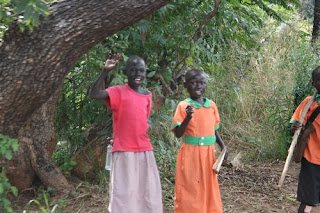
A child’s wave and cry of exultation at the glimpsed white stranger
Lifts my heart to soar again. Hope hovers by.
 Stephen Waldron
Saturday, October 4, 2008
The flavour of Uganda
I never seem to fully communicate the flavour of Uganda and get you to smell the smells and sense the sensations, so this Blog’s purpose is just that!
1. We learnt recently that until very recently women were not allowed to eat chicken – the preserve of men alone!
2. The Buganda (main tribe, and our area) greet by falling on their faces (women) before each other and before men (I love it!!) – but tribes from the south of Uganda actually hug and kiss each other on both cheeks!
3. A couple of people were arrested recently in Kampala for selling dog meat as goat meat; it seems that elsewhere in Africa, e.g. Nigeria, dog meat is prized and there are special dog meat butchers.
4. Ugandan men (and some women!) find it quite acceptable to pee at the side of the road.
5. You should never talk to a Ugandan woman about being pregnant and NEVER touch her tummy (not that I ever do) – this is seen as an attempt to curse the baby or put witchcraft on the child.
6. The bodaboda driver is quite happy to carry two or three passengers as long as they realise it costs more than one. 6 incl. driver is the maximum I have seen to date.
7. Men here are generally more fanatical supporters of English Premier League teams than the English.
8. Tilapia, the main local fish of Lake Vic, beats cod and haddock any day, but is an ugly brute. Best eaten chargrilled, with ones fingers.
9. One of the regular ‘village’ jobs of women out here (that really upsets me) is stone breaking; women sit with babies on their backs hammering rocks on a large stone to create aggregate of different sizes for concreting, which they sort into piles around them, for which they get paid a pittance; they never wear protective glasses and Lord knows how many of them go blind.
10. The driving … LORDY LORDY! The driving …. not enough room here to describe. There are no rules, be clear on that point at least.
11. Ugandans don’t generally discuss important things with each other (unless very, very close friends) because showing any interest is seen as an opening to offer financial help – which everyone is always looking for - such a sponsorship for children at school (there is no such thing as free education in Uganda whatever the government says); so conversation tends towards being shallow and dull – almost an art form; this is apparently why mzungus (ex-pats) get into such trouble being asked to provide financial assistance – we show too much interest in people!
12. Lake flies and grasshoppers are delicacies here – crunchy fries, mmmmmm!
13. Papyrus is no longer found in Egypt but abounds here around Lake Vic.’ a papyrus mat or screen 2m x 3m costs 70p - I use it as one of my key materials in construction out here as a shade screen etc.
14. A common site here is a bodaboda carrying a massive, live sow on the back, strapped up rather fetishistically, or an 85kg Nile Perch protruding from a vast sack. No-one blinks an eye!
15. For Ugandans a woman’s most provocative part of their body is their bottom. Breasts are, apparently, boring. I have yet to work out what a sexy bottom looks like to a Ugandan because it is a no-go topic of conversation….! However one could balance a full tea-tray on the top part of the bottoms of many women in this part of Africa, although I have yet to see this.
16. Bilharzia is a deadly disease caused by microscopic flukes in the liver, which the BBC website will tell you comes from swimming in the lakes, but in fact you get it from any contact with any infected water; I have it (because of my sailing) but am now in a sort of safe symbiotic stasis with several of the worms living in me and defending their territory against all invaders – all of which keeps me safe!!
17. Entebbe, the old capital of Uganda, has not a single public butcher’s shop with fridges or cold stores for keeping meat, let alone separate cutting boards for different things.
18. 50% of all deaths on the roads (which occur 100 times more per capita than the UK) involve bodabodas (mopeds) – about 16 deaths a month in Kampala city each month alone; now you know how terrified I am of driving my bodaboda and how exhausted I am after every trip!
19. Wherever a Westerner goes in Uganda the children will scream out incessantly, “Bye, Mzungu!” and not stop until you reply (Mzungu is their word for stranger – its not meant to be insulting). It can get a bit waring …..
20. Go to the National Livestock Research Centre, Entebbe, to get help with an infection with your birds. They will have no medicines or vaccines to treat them although they are the national centre for breeding Uganda’s chicken!
21. Pineapple cost from 25p; mangos from 13p; a huge hand of bananas 65p; massive avocadoes from 13p; pawpaw from (papaya) 45p; it’s heaven!!
22. Women must have multi-jointed hips; they bend 130° from the waist. This means that they can stand upright but pivot down above the waist and wash the floor with their palms spreading a large floorcloth - for hours at a time.
23. You haven’t really experienced thunder and lighting until you come to the northern shore of Lake Vic – Kampala is the lighting capital of the world! The cacophony continues for up to two hours within the same location with maybe 10 and minute. The thunder is louder and more intense than anything in the UK. Nearly every night one can look out to the lake and se in the distance somewhere an amazing firework display of the heavens. It’s awesome and beautiful - until one is under it!
24. You get on a taxibus and the conductor tells you the intended journey is 100USh more than you know it to be. All the Ugandans inside are also being cheated and agree with you that it is too much, but none of them says anything. You complain and insist on getting off and at the stop find the bus immediately behind you will charge the right price, at which point everyone on the first bus gets off and joins you. But no Ugandan will challenge the wrong price themselves – not even when in a gang!
25. 51% of all Ugandans are aged below 15. Kids are everywhere! They are intoxicatingly happy, beautiful and FULL OF LIFE!
26. T-Bone steak form the very best butcher in Kampala – superb quality – costs £2.50/kg or £1.13/lb.
27. When you enter a house the person entering should greet the owner, not the other way round. So when you go shopping at a local/village shop the shopkeeper will expect you to greet him not him to greet you. So customer service starts on the wrong foot!
28. Ugandan skin is like black satin or velvet; one wants to reach out and stroke it …… there is almost no body hair.
29. A regular sight is a dog lying dead in the middle of the road. This tends to happen mostly on Saturday nights for some unknown reason – Sunday trips to church are most unpleasant! No-one ever seems to remove the carcasses so the stench by Wednesday affects a long stretch of road. I do have a satirical comic sketch I have written on this subject, but not for here!!
30. Queuing is a western art, and don’t forget it!
31. Ugandan men have a habit of walk along clutching their groin area of their trousers in bad weather to keep their trousers out of the mud. It’s not a pretty sight.
32. Police override the traffic lights when directing traffic at junctions – although the lights carry on operating as normal. Police don’t seem to understand that this probably is more likely to cause accidents ….
33. A constant background noise is the sound of a colony of male weaver birds chattering as they weave their nests.
34. Fetching water in jerrycans from the lake or village pump is a task for children from as young as two years old.
Have you got the flavour?
1. We learnt recently that until very recently women were not allowed to eat chicken – the preserve of men alone!
2. The Buganda (main tribe, and our area) greet by falling on their faces (women) before each other and before men (I love it!!) – but tribes from the south of Uganda actually hug and kiss each other on both cheeks!
3. A couple of people were arrested recently in Kampala for selling dog meat as goat meat; it seems that elsewhere in Africa, e.g. Nigeria, dog meat is prized and there are special dog meat butchers.
4. Ugandan men (and some women!) find it quite acceptable to pee at the side of the road.
5. You should never talk to a Ugandan woman about being pregnant and NEVER touch her tummy (not that I ever do) – this is seen as an attempt to curse the baby or put witchcraft on the child.
6. The bodaboda driver is quite happy to carry two or three passengers as long as they realise it costs more than one. 6 incl. driver is the maximum I have seen to date.
7. Men here are generally more fanatical supporters of English Premier League teams than the English.
8. Tilapia, the main local fish of Lake Vic, beats cod and haddock any day, but is an ugly brute. Best eaten chargrilled, with ones fingers.
9. One of the regular ‘village’ jobs of women out here (that really upsets me) is stone breaking; women sit with babies on their backs hammering rocks on a large stone to create aggregate of different sizes for concreting, which they sort into piles around them, for which they get paid a pittance; they never wear protective glasses and Lord knows how many of them go blind.
10. The driving … LORDY LORDY! The driving …. not enough room here to describe. There are no rules, be clear on that point at least.
11. Ugandans don’t generally discuss important things with each other (unless very, very close friends) because showing any interest is seen as an opening to offer financial help – which everyone is always looking for - such a sponsorship for children at school (there is no such thing as free education in Uganda whatever the government says); so conversation tends towards being shallow and dull – almost an art form; this is apparently why mzungus (ex-pats) get into such trouble being asked to provide financial assistance – we show too much interest in people!
12. Lake flies and grasshoppers are delicacies here – crunchy fries, mmmmmm!
13. Papyrus is no longer found in Egypt but abounds here around Lake Vic.’ a papyrus mat or screen 2m x 3m costs 70p - I use it as one of my key materials in construction out here as a shade screen etc.
14. A common site here is a bodaboda carrying a massive, live sow on the back, strapped up rather fetishistically, or an 85kg Nile Perch protruding from a vast sack. No-one blinks an eye!
15. For Ugandans a woman’s most provocative part of their body is their bottom. Breasts are, apparently, boring. I have yet to work out what a sexy bottom looks like to a Ugandan because it is a no-go topic of conversation….! However one could balance a full tea-tray on the top part of the bottoms of many women in this part of Africa, although I have yet to see this.
16. Bilharzia is a deadly disease caused by microscopic flukes in the liver, which the BBC website will tell you comes from swimming in the lakes, but in fact you get it from any contact with any infected water; I have it (because of my sailing) but am now in a sort of safe symbiotic stasis with several of the worms living in me and defending their territory against all invaders – all of which keeps me safe!!
17. Entebbe, the old capital of Uganda, has not a single public butcher’s shop with fridges or cold stores for keeping meat, let alone separate cutting boards for different things.
18. 50% of all deaths on the roads (which occur 100 times more per capita than the UK) involve bodabodas (mopeds) – about 16 deaths a month in Kampala city each month alone; now you know how terrified I am of driving my bodaboda and how exhausted I am after every trip!
19. Wherever a Westerner goes in Uganda the children will scream out incessantly, “Bye, Mzungu!” and not stop until you reply (Mzungu is their word for stranger – its not meant to be insulting). It can get a bit waring …..
20. Go to the National Livestock Research Centre, Entebbe, to get help with an infection with your birds. They will have no medicines or vaccines to treat them although they are the national centre for breeding Uganda’s chicken!
21. Pineapple cost from 25p; mangos from 13p; a huge hand of bananas 65p; massive avocadoes from 13p; pawpaw from (papaya) 45p; it’s heaven!!
22. Women must have multi-jointed hips; they bend 130° from the waist. This means that they can stand upright but pivot down above the waist and wash the floor with their palms spreading a large floorcloth - for hours at a time.
23. You haven’t really experienced thunder and lighting until you come to the northern shore of Lake Vic – Kampala is the lighting capital of the world! The cacophony continues for up to two hours within the same location with maybe 10 and minute. The thunder is louder and more intense than anything in the UK. Nearly every night one can look out to the lake and se in the distance somewhere an amazing firework display of the heavens. It’s awesome and beautiful - until one is under it!
24. You get on a taxibus and the conductor tells you the intended journey is 100USh more than you know it to be. All the Ugandans inside are also being cheated and agree with you that it is too much, but none of them says anything. You complain and insist on getting off and at the stop find the bus immediately behind you will charge the right price, at which point everyone on the first bus gets off and joins you. But no Ugandan will challenge the wrong price themselves – not even when in a gang!
25. 51% of all Ugandans are aged below 15. Kids are everywhere! They are intoxicatingly happy, beautiful and FULL OF LIFE!
26. T-Bone steak form the very best butcher in Kampala – superb quality – costs £2.50/kg or £1.13/lb.
27. When you enter a house the person entering should greet the owner, not the other way round. So when you go shopping at a local/village shop the shopkeeper will expect you to greet him not him to greet you. So customer service starts on the wrong foot!
28. Ugandan skin is like black satin or velvet; one wants to reach out and stroke it …… there is almost no body hair.
29. A regular sight is a dog lying dead in the middle of the road. This tends to happen mostly on Saturday nights for some unknown reason – Sunday trips to church are most unpleasant! No-one ever seems to remove the carcasses so the stench by Wednesday affects a long stretch of road. I do have a satirical comic sketch I have written on this subject, but not for here!!
30. Queuing is a western art, and don’t forget it!
31. Ugandan men have a habit of walk along clutching their groin area of their trousers in bad weather to keep their trousers out of the mud. It’s not a pretty sight.
32. Police override the traffic lights when directing traffic at junctions – although the lights carry on operating as normal. Police don’t seem to understand that this probably is more likely to cause accidents ….
33. A constant background noise is the sound of a colony of male weaver birds chattering as they weave their nests.
34. Fetching water in jerrycans from the lake or village pump is a task for children from as young as two years old.
Have you got the flavour?
Saturday, July 26, 2008
Venice; 1.07.08.
Venice always evokes in me strange passions. The sheer undiluted extent of its beauty astounds me. One can visit Florence and see the sights but know that even there, round the corner, there will be disappointment, even slums. But here in Venice the beauty, intensity and passion of spaces that excite and delight goes on street after piazza after canal.
I try to analyse its success. So many scholars and academics – generals of the artistic world - have tried and studied this great city; I am merely a foot soldier trying to understand his terrain. The narrowness of the arterial bending, twisting streets, overlaid and interlaced with contrasting sinews of water of endlessly varying breadths is the main theme my mind distinguishes. But then there is the endless flickering of reflected rippling dappled light dancing seductively on the underside of the hundreds of bridges and up and along the sheer flanking walls. There are the never-ending steel-tipped gondolas drifting lazily through these veins, slapping a staccato through the constant percussion of shoes along the fissured alleyways. The properties of a tightly controlled language of finishes, windows and doorways; the fading glory of exotically painted walls; the glimpses around and through openings into hidden courtyards awash with flowers – mostly geraniums and vines; the punctuating solidity of medieval and classical churches, civic buildings and theatres with their dark, heavy interiors packed full of artisan craftsmanship; the sudden explosive entry into sun-scorched courtyards and piazzas whose generous proportions contrast so strongly with the cool, shadowy, crack-like chasms that lead to them.
I love that I never know if the next alley will lead to a dead-end set of steps to a canal landing, or into square, or round a tight, hidden bend and beyond. I love the lack of an Oxford Street or Bluewater mall. Shops spring into view in the most idiosyncratic places. This is true shopping; trying to find the shops is the biggest part of the adventure!
As one climbs the steps of the miniscule bridges, under which the gondoliers duck at the last moment with that mixture of staggeringly grandiose arrogance and skill, the resulting subtle shift of viewpoint down and along the canals is one of the most exquisite charms of the Venetian experience. What is around that last corner, I wonder? Many Venetians have opened up an arch from the canals into the very heart of their home, where often an ancient chocolate-coloured armchair sits shrouded with silks and embroidered tapestries, telling of the wealth – true or imagined – of the owner.
Windows packed with carnival masks, grinning and gawping at me. Sheer perfection in colour and finish, fresh with the smell of turpentine, which pervades the deepest of alleyways. I pause and breathe in deeply and I am back in the apprentice studios of Da Vinci or Michelangelo. Lines upon banks of sightless, silent faces, all holding a lost language of intrigue and occult behaviours, refusing to tell their stories. Huge feathers sprout from every nook and corner, like ferns in a spume-soaked waterfall grotto. Headdresses fit for princes and princesses, nobles and baronesses abound, each one placed with care and precision.
People move slowly and aimlessly, silenced by the sheer volume and never-ending feast of history and pageant. I feel I am part of a tender deep dance of slumber. Even the most brash tourists seem strangely muffled by the lapping water and embracing walls, by a silence that crushes the intrusive clamours of a modern, hurtling world. Here we slowly and intuitively sense with a growing internal hollowness just what has been lost along the way. How that progress is really a master of deceit. How easily we have fallen for our own lies! How much has been lost amongst the gains. I overhear one of two garish American women remarking that in Las Vegas she visited a life-sized copy of Venice’s Grand Canal, but …. and she gasps for air and for words, eyes rolling, as she acknowledges the sheer outrage of the comparison.
How did we lose this? What created it and made it possible in the first place? I can guess at the answers but clarity eludes me. Something about immense trading wealth, coupled with the centrality of art and creativity, the high calling of being a commissioning patron, and above it all a belief of the essence of God in all things, sacred and secular – in fact the indivisibility of life. There is no secular in Venice; God is everywhere. He breathes through the stones.
I try to analyse its success. So many scholars and academics – generals of the artistic world - have tried and studied this great city; I am merely a foot soldier trying to understand his terrain. The narrowness of the arterial bending, twisting streets, overlaid and interlaced with contrasting sinews of water of endlessly varying breadths is the main theme my mind distinguishes. But then there is the endless flickering of reflected rippling dappled light dancing seductively on the underside of the hundreds of bridges and up and along the sheer flanking walls. There are the never-ending steel-tipped gondolas drifting lazily through these veins, slapping a staccato through the constant percussion of shoes along the fissured alleyways. The properties of a tightly controlled language of finishes, windows and doorways; the fading glory of exotically painted walls; the glimpses around and through openings into hidden courtyards awash with flowers – mostly geraniums and vines; the punctuating solidity of medieval and classical churches, civic buildings and theatres with their dark, heavy interiors packed full of artisan craftsmanship; the sudden explosive entry into sun-scorched courtyards and piazzas whose generous proportions contrast so strongly with the cool, shadowy, crack-like chasms that lead to them.
I love that I never know if the next alley will lead to a dead-end set of steps to a canal landing, or into square, or round a tight, hidden bend and beyond. I love the lack of an Oxford Street or Bluewater mall. Shops spring into view in the most idiosyncratic places. This is true shopping; trying to find the shops is the biggest part of the adventure!
As one climbs the steps of the miniscule bridges, under which the gondoliers duck at the last moment with that mixture of staggeringly grandiose arrogance and skill, the resulting subtle shift of viewpoint down and along the canals is one of the most exquisite charms of the Venetian experience. What is around that last corner, I wonder? Many Venetians have opened up an arch from the canals into the very heart of their home, where often an ancient chocolate-coloured armchair sits shrouded with silks and embroidered tapestries, telling of the wealth – true or imagined – of the owner.
Windows packed with carnival masks, grinning and gawping at me. Sheer perfection in colour and finish, fresh with the smell of turpentine, which pervades the deepest of alleyways. I pause and breathe in deeply and I am back in the apprentice studios of Da Vinci or Michelangelo. Lines upon banks of sightless, silent faces, all holding a lost language of intrigue and occult behaviours, refusing to tell their stories. Huge feathers sprout from every nook and corner, like ferns in a spume-soaked waterfall grotto. Headdresses fit for princes and princesses, nobles and baronesses abound, each one placed with care and precision.
People move slowly and aimlessly, silenced by the sheer volume and never-ending feast of history and pageant. I feel I am part of a tender deep dance of slumber. Even the most brash tourists seem strangely muffled by the lapping water and embracing walls, by a silence that crushes the intrusive clamours of a modern, hurtling world. Here we slowly and intuitively sense with a growing internal hollowness just what has been lost along the way. How that progress is really a master of deceit. How easily we have fallen for our own lies! How much has been lost amongst the gains. I overhear one of two garish American women remarking that in Las Vegas she visited a life-sized copy of Venice’s Grand Canal, but …. and she gasps for air and for words, eyes rolling, as she acknowledges the sheer outrage of the comparison.
How did we lose this? What created it and made it possible in the first place? I can guess at the answers but clarity eludes me. Something about immense trading wealth, coupled with the centrality of art and creativity, the high calling of being a commissioning patron, and above it all a belief of the essence of God in all things, sacred and secular – in fact the indivisibility of life. There is no secular in Venice; God is everywhere. He breathes through the stones.
Uganda seen from afar
‘Does Uganda still exist?’ my mind tussles with this thought as I relax and unwind in a far-flung world, hidden deep in a mountain valley in the Italian Friuli Mountains. It seems impossible that such differing worlds can coexist in such a small and diminishing planet. I am in the centre of civilisation. At least, I mean civilisation from which my world was spawned. Civilisation from which nearly everything that I value and take for granted has sprung. Values that support and uphold me and make me glad to be alive. This is the backdrop to words, lines, duets, concertos, arias, operas, plays, poems and symphonies that resonate through my being.
Am I wanting the same for Uganda? No – something unique and different! But can I identify and accept the values and beauty that make Uganda what it is and what it could be? Or does it need to go through the world wars and plagues that shaped Europe into what it is today to be able to compete on this stage? Can we get something so wonderful for nothing? What is the essential-ness of Uganda that I need to extol and laud? What qualities and elements do I need to recognise within the chaos and corruption?
Fear and loathing in Uganda - methinks. I am finding it hard to work my way through the utter waste of lives and effort – of human potential represented by the rhythm and way of Ugandan life – even if this is less than half the truth.
Firstly there is the corruption. No! I am not going to give in to the ‘politically correct’ mist that invades my brain and seeks to cloud every true judgement. Of course there are reasons for corruption, and endless extenuating circumstances, but the fact is, no matter how you dress it up, that until corruption is significantly reduced there is no hope for Uganda. You just can’t make a silk purse out of a sow’s ear.
Then there is tribalism. Every Ugandan I meet dreads the knock on his door or the ring on his mobile of the distant relative or clansman asking for yet another favour. On the one hand it is wonderful to have an extended family that means you are never in want for a home or a bed. But the country is littered and crawling with half-built structures representing the people’s attempts to tie up their money away from the hands of others. It is an abomination and scourge; a promotion or benefit is lost immediately by the relatives who will camp nearby to eat up the crumbs that fall from the table. A greater educational qualification is a signal to people from distant shores to relocate nearer their family member. A deep sigh rumbles from the belly of every successful but caring wife that I meet in Uganda; “What can you do?” she sighs. “They are our flesh and blood”.
At a broader level jobs are always given to one’s family or tribe, never outside the fold. The contempt and hostility from one’s family if one failed to do so would be too much to bear. There is no concept of ‘the best for the job’. Indeed suspicion is so great between people that the worst are often selected, who will never ever threaten the benefactor’s position, but who, at the same time, will never ever advance his cause. This behaviour is not limited to ‘evil’ or ‘ignorant’ people, but even the very best of men and women cannot see any other way to act, unless they have experienced life in the West.
So what does Uganda offer the world? Gentle, hospitable, softly spoken people who work hard; graciousness; a country of great agricultural potential with a superb climate in most of the central and southern areas; significant untapped mineral wealth; beautiful women!; hydro-electric power; amazing bird-life; Tilapia; biggest crocodiles in world; masses of hippos, crocs, and elephant; much much more ……
Am I wanting the same for Uganda? No – something unique and different! But can I identify and accept the values and beauty that make Uganda what it is and what it could be? Or does it need to go through the world wars and plagues that shaped Europe into what it is today to be able to compete on this stage? Can we get something so wonderful for nothing? What is the essential-ness of Uganda that I need to extol and laud? What qualities and elements do I need to recognise within the chaos and corruption?
Fear and loathing in Uganda - methinks. I am finding it hard to work my way through the utter waste of lives and effort – of human potential represented by the rhythm and way of Ugandan life – even if this is less than half the truth.
Firstly there is the corruption. No! I am not going to give in to the ‘politically correct’ mist that invades my brain and seeks to cloud every true judgement. Of course there are reasons for corruption, and endless extenuating circumstances, but the fact is, no matter how you dress it up, that until corruption is significantly reduced there is no hope for Uganda. You just can’t make a silk purse out of a sow’s ear.
Then there is tribalism. Every Ugandan I meet dreads the knock on his door or the ring on his mobile of the distant relative or clansman asking for yet another favour. On the one hand it is wonderful to have an extended family that means you are never in want for a home or a bed. But the country is littered and crawling with half-built structures representing the people’s attempts to tie up their money away from the hands of others. It is an abomination and scourge; a promotion or benefit is lost immediately by the relatives who will camp nearby to eat up the crumbs that fall from the table. A greater educational qualification is a signal to people from distant shores to relocate nearer their family member. A deep sigh rumbles from the belly of every successful but caring wife that I meet in Uganda; “What can you do?” she sighs. “They are our flesh and blood”.
At a broader level jobs are always given to one’s family or tribe, never outside the fold. The contempt and hostility from one’s family if one failed to do so would be too much to bear. There is no concept of ‘the best for the job’. Indeed suspicion is so great between people that the worst are often selected, who will never ever threaten the benefactor’s position, but who, at the same time, will never ever advance his cause. This behaviour is not limited to ‘evil’ or ‘ignorant’ people, but even the very best of men and women cannot see any other way to act, unless they have experienced life in the West.
So what does Uganda offer the world? Gentle, hospitable, softly spoken people who work hard; graciousness; a country of great agricultural potential with a superb climate in most of the central and southern areas; significant untapped mineral wealth; beautiful women!; hydro-electric power; amazing bird-life; Tilapia; biggest crocodiles in world; masses of hippos, crocs, and elephant; much much more ……
Friday, July 4, 2008
Postcard from holiday
It is post-wedding - ‘Life after wedding’. What sort of life is ‘life after’? My daughter has gone; left father and mother and cleaved to a husband – united to him for life, for better for worse, richer or poorer. It is a strange time of life. I feel suddenly very old and quite, quite sorry for myself.
I am up in the Friuli Mountains, Tarcento, NE Italy. Sandy and I have been given the use of a small cottage for a week with our youngest, Hannah, by dear friends. We have been awed by the spectacular peaks and sublime (Hannah’s word) vistas. Jagged, toothed, glaciated walls many hundreds of metres high that feel ready to collapse at any time and wipe us out. The area bears the hallmarks of the terrible earthquake of 1976 that killed hundreds and destroyed its medieval buildings. It is good to be awed now and again. To be humbled and to recognise something far, far bigger and more majestic then my ego and small insignificant life which too often is all consuming and important beyond words. They say we spend 90% of our time thinking about ourselves. Narcissism. This landscape stirs my spirit and lifts my head up out of a spiral downwards towards some inner abyss.
I have also just finished reading ‘The Shack’, by William P Young. Or, rather, it finished reading me! I was sat next to Hannah, with tears coursing down my cheeks, and hoping that she wouldn’t notice these, or the sniffs that punctuated the silence.
A true holiday; being exposed to thoughts and experiences that slowly percolate through the tough, blocked passages of my life, furred up and calcified by a hundred disappointments, crises and conflicts – without and within – that need their grip shifting and loosening. I am relaxing and even ‘doing nothing’!
I am facing the thought of return to Uganda, and a strange concoction of unknown and familiar sounds sights and smells infuse my thoughts. I thought that I would be joyous, such is my love of the life, work and activity out there, but I find that instead I am tormented by doubts and fears. A sickness lurks in the pit of my stomach. Instead of triumphs and successes I can only think of my failures and the difficulties. I am worrying about my legacy there. I am constantly saddened and ashamed of things I have done and feelings that I have had. I so longed to make a good start and to travel a good road. I had a picture of a medieval Franciscan monk walking along communing with his God, in harmony with nature, and blessing each person he meets. But I realise that I have taken the same ‘me’ into Uganda, and what needs to change is not the surroundings but my internal landscape. I can’t change the past. I can’t even change ‘me’. But I can allow Truth to work its effects within me and to walk the road less travelled – and that means more conscious of God by my side, redeeming each situation that seems to be a ‘Snake and Ladders’ slide back into past failures.
So, I realise the wedding has been a milestone. It has reminded me of a point reached, beyond which it is too late to change the past. We are here and not there.
The danger is that I now will start to feel sad and sorry for myself, and be overwhelmed with morose thoughts, instead of grasping with a sense of elation the possibility of being different and having the opportunity to be renewed within.
I am resolved to walk forwards and into Cherish. I will cherish each day. I will cherish each person. I will cherish each opportunity to be a blessing. I will cherish each small dying of ‘me’ and each new shoot of life that bursts out.
Because I am beginning to realise just how much I am cherished.
I am up in the Friuli Mountains, Tarcento, NE Italy. Sandy and I have been given the use of a small cottage for a week with our youngest, Hannah, by dear friends. We have been awed by the spectacular peaks and sublime (Hannah’s word) vistas. Jagged, toothed, glaciated walls many hundreds of metres high that feel ready to collapse at any time and wipe us out. The area bears the hallmarks of the terrible earthquake of 1976 that killed hundreds and destroyed its medieval buildings. It is good to be awed now and again. To be humbled and to recognise something far, far bigger and more majestic then my ego and small insignificant life which too often is all consuming and important beyond words. They say we spend 90% of our time thinking about ourselves. Narcissism. This landscape stirs my spirit and lifts my head up out of a spiral downwards towards some inner abyss.
I have also just finished reading ‘The Shack’, by William P Young. Or, rather, it finished reading me! I was sat next to Hannah, with tears coursing down my cheeks, and hoping that she wouldn’t notice these, or the sniffs that punctuated the silence.
A true holiday; being exposed to thoughts and experiences that slowly percolate through the tough, blocked passages of my life, furred up and calcified by a hundred disappointments, crises and conflicts – without and within – that need their grip shifting and loosening. I am relaxing and even ‘doing nothing’!
I am facing the thought of return to Uganda, and a strange concoction of unknown and familiar sounds sights and smells infuse my thoughts. I thought that I would be joyous, such is my love of the life, work and activity out there, but I find that instead I am tormented by doubts and fears. A sickness lurks in the pit of my stomach. Instead of triumphs and successes I can only think of my failures and the difficulties. I am worrying about my legacy there. I am constantly saddened and ashamed of things I have done and feelings that I have had. I so longed to make a good start and to travel a good road. I had a picture of a medieval Franciscan monk walking along communing with his God, in harmony with nature, and blessing each person he meets. But I realise that I have taken the same ‘me’ into Uganda, and what needs to change is not the surroundings but my internal landscape. I can’t change the past. I can’t even change ‘me’. But I can allow Truth to work its effects within me and to walk the road less travelled – and that means more conscious of God by my side, redeeming each situation that seems to be a ‘Snake and Ladders’ slide back into past failures.
So, I realise the wedding has been a milestone. It has reminded me of a point reached, beyond which it is too late to change the past. We are here and not there.
The danger is that I now will start to feel sad and sorry for myself, and be overwhelmed with morose thoughts, instead of grasping with a sense of elation the possibility of being different and having the opportunity to be renewed within.
I am resolved to walk forwards and into Cherish. I will cherish each day. I will cherish each person. I will cherish each opportunity to be a blessing. I will cherish each small dying of ‘me’ and each new shoot of life that bursts out.
Because I am beginning to realise just how much I am cherished.
Saturday, April 19, 2008
What I came to Uganda for .. the real task as it unfolds: construction/design
 Time to talk about the job I do again instead of the pastimes and leisure pursuits! This blog will be about the building side of things. The picture adjacent shows how seriously I take my work!
I am part of a team and NGO called ‘Cherish Uganda’, and we are building the first village in Uganda (we think) for orphans and abandoned children who are HIV+ of whom there are upwards of 50,000. There is AIDCHILD in Mpigi and Musaka but their model is the more traditional dormitory orphanage. Ours consists of individual simple houses with a mother and up to 8 children with each home (Positive Home) being
 independently run - like a real family. The site is based around a working farm, where we grow all the food for the children and mothers and are slowly moving towards a livestock component.
The site will have at least 25 Positive Homes eventually (200 children); currently we have built three and two more are about to start. They cost about £13,000/$26,000 each fully equipped, and we build everything using a trained team of men from the local village plus a few specialists from further away.
 The whole site is a demonstration in sustainable design and construction, with an emphasis on water conservation. We utilise our own home made bricks (burnt), home made cookers (Lorena ‘Rocket’ stoves) and bio-sand filters to provide drinking water. Our toilets are Ecosan composting type and the waste products are used on the land. Each house has a solar hot water system and solar electric system; they have no water connection but rely 100% on rainwater harvesting. There are no ceilings and yet the houses are very cool (but noisy when it rains!!).
 Also on the site will be a farm, a school, and an admin block. The latter is a refurbishment and extension project and is nearing completion, having dramatically remodelled a set of shambolic buildings (if they could be described as that) into a really dynamic building.
We are also planning a children’s club house and various other communal life buildings.
My job is to design and project-manage the entire construction and infrastructure for the site, and also to spearhead and manage the entire organic farm – which currently is an intensively cultivated 7 acres. It’s a huge task but I love the combination of my Tropical Agricultural Development training and my architectural experience, especially energy and water conservation.

I and Chris White have designed our own ‘first-flush’ devices (on Mark III now) to discharge the first (dirty) rainwater off the roofs and then accept only the cleaner, later flows. I also have tried laying a shade roof of papyrus on a eucalyptus frame over the tin roofs, and this proved to greatly reduce thermal impacts on the rooms below, for next to no cost. I love papyrus and have used it also as screen walls for grain stores.
We have a great team of characters called ‘builders’ from the local village, led by Richard the foreman, a tall Ugandan. We recently bought them all work clothes with logos embroidered on. and boots and socks, and they went wild! Sam Bbosa is our wonderful, humble and servant-hearted Ugandan assistant construction manager working under Fin Wo od’s direction.
We recently were donated the money to buy a brand new cement mixer!! Wow! What a difference it makes. Now work flies along. The two bandas I have designed overlooking Lake Victoria are going up fast and this weekend we expect the mountain bamboo and thatch roof to arrive with the roofing team from Karamoja, in NE Uganda.
It has been an intense spring rain season. As a result we got a few supply lorries bogged down delivering materials and we have had to throw together a track to serve the site. The site is located under a huge ‘Muwafu Tree’ in which a pair of Fish Eagles nests and emits harsh and raucous cries, just audible above the cement mixer!
The main challenges of the construction side are:
1) trying to get people to programme and plan ahead; it just doesn’t happen naturally here!
2) asking people to read a drawing; same again
3) asking people to do something slightly differently to normal; WHATTTT!!!!!
4) getting people to do exactly what has been asked (and demonstrated about 3 times over) and not something ‘sort of like’ what we asked! 
….basically it is just about impossible to leave the site for more than about 30 minutes, no exaggeration. On the other hand the guys are great fun and work hard for relatively little money although we are careful to pay above local minimum wage rates. Labour is cheap in the developing world.
My aim is to:
· create spaces that feel homely and safe;
· to use materials and techniques where I can that are local and vernacular;
· to minimise the impact upon this planet and this part of it especially; 
· to keep costs to the minimum;
· to avoid doing anything that is unnecessary;
· to forget about the architectural press and media;
· to prove that water comes from the sky and not from a tap and that is enough;
· to persuade that toilets without water are sensible and safe;
· to persuade that solar power on the equator makes sense at every level!
It is encouraging when people come to visit. The typical comment is: “I never thought that it was as big a vision and such a complex project!”; or, “I thought you were building a few small mud huts and not something as good as this!”; or, “Wow! This is amazing!” It helps keep us motivated and inspired as we sometimes forget that all these comments are true.
Jesus Christ is my inspiration, and God decided to send him as a carpenter for 30+ years of pre-ministry training. Plus God is the architect of the universe. So I feel pretty OK about my role out here!
Photos from top: my attempt to grow a beard while my wife was away, and the affects of madness; banda and cement mixer in foreground in intense rain; banda afew days later; admin building on the track side, complete apart from decs; Pastor Benson from Karamoja with Gerry and Richard; a 'Positive Home' in the landscape; view from the water tower over our land towards Lake Victoria.
Sunday, March 30, 2008
Lake Mburu National Park ...mmmmmmmmm!!!
 Mihingo Lodge, Mburu Lake National Park
Somehow I did the unimaginable and won top prize in a raffle at my sailing club - a full day’s board at one of the newest and most upmarket safari lodges in Uganda!! One of the team had given us enough money at Christmas for us to buy a second day, and so off we went to Mihingo Lodge, Mburu Lake National Park, on the Tanzania side of the main road between Musaka and Mbarara (look it up on the Web). The owners also own and run ‘Banana Boat’, the top shop chain in Uganda for tourist artefacts of local indigenous craft.
Perched high on a rock outcrop overlooking the national park, the lodge is an ecological dream. All water is rainwater, collected from the rock slopes and harvested and pumped by solar power to the 200,000L irrigation tank and then down to the bandas. Hot water comes from individual solar hot water panels, and the lighting from a solar PV panel on the same mounting. The bandas are set into the hill slope, built from sustainable timber and thatch with
 a tent set within for the bedroom. Each has a large veranda from which there is a view over the plain, surrounding hills, and the water hole, where Waterbuck, Impala, Zebra, Buffalo and Warthogs abound. The double bed was vast, with a superb mattress, and completely swathed by well-fitted mosquito netting.
How amazing – to stay somewhere with high quality ‘everything’! In Uganda! It IS possible after all. We don’t usually move in such rarefied atmosphere; I find these all-too-rare experiences reassure me and encourage me to keep my vision aimed high. Eating medallions of marinaded pork, and served with a fresh and excellent salad, I felt more hope rising!
A nice touch is the use throughout of beautiful, locally-made paper, and particularly the stories by each of the 20 staff members typed onto the paper, laminated, and set in a leather box for visitors to read. It is rare for staff to be given this sort of prominence, and it feels really good. It is not patronising. Good idea, I think …… (hhmmmmmm).
The walk down (and up, rather!) to the bandas from the lodge is steep (hundreds of rocky steps) and meanders between a dense, gnarled woodland, mostly wild olive. At night staff set 30 or more paraffin lamps along the path, turning it into a fairy grotto experience.
The best part for me was a boat trip on Lake Mburu. We must have seen about 18 Fish Eagles, along with a mother croc and her littl’uns, lots of hippo, various different types of kingfisher and heron, and more buffalo – very close up. The lake is named after a local inhabitant whose brother was warned in a dream that the area would be flooded and left for the local mountains (which are named after him), but Mburu stayed and was killed in the flood, which created the Lake. Myth, but good myth.

On the way back I had arranged to pick up a young man from a small village near Mbarara, Edgar (not his real name) who had been sponsored for 3 years by an English couple to be at school and learn carpentry. They had simply stumbled across him as they parked their car on a track near his village three years ago; they had been captivated by him and offered to pay his fees by ‘Western Union’. He called it “his miracle”, and I could only agree. In response to an email ‘round robin’ I had offered to try and see if he could be apprenticed with one of our carpenters on site. Anyway, his story captures some of the heartache of so many young people. His father died of AIDS when he was very young, and at 14 his mother also died of AIDS. He was left to bring up a younger brother (aged 4) who was dumb and mentally retarded, and two sisters. Each has several children. He had to be a breadwinner for them and so had missed out on school. Last October, at 14, his brother strangled the sister’s 2-year old baby boy and dumped him in the swamp. Edgar had rescued him from being killed by the villagers and had managed to get him somehow 200 km to the (excellent) mental hospital in Kampala, never having been outside Mbarara before! He left on Good Friday with us, without telling his two sisters; he had recently been informed by the hospital that he had to take back his brother as he was now well enough to return home. You can imagine that the villagers in such a remote area are not going to accept him back – they want him dead. Also the sponsorship money had not been enough to pay for the practical carpentry module at the vocational college, just the theory, so in fact he had never even handled carpentry tools!
None of this had been known by the sponsors, but I knew we had walked into a larger than life, but very real, situation!! I also knew that this was a lovely young man, full of faith, joy and hope, he had ‘lost’ his childhood in the service of his family, had no-one, and desperately needed help. Most people tell us not to get involved in such situations (we do - regularly), as there are thousands of stories like Edgar’s. But how can we “love our neighbour as ourselves” and walk away? My faith struggles with such ambiguity. Others may cope with it, but I find it hard to look God in the eye and turn away.

We have set him up in simple accommodation in the village here. As I write we have had him round for the day (Easter Sunday) having taken him to church and then had a sumptuous barbecue, together with our housegirl Christine, her baby Asher, and an orphan, Prossie, whom we sponsor at a local school. What an appropriate day! Easter! New life, new hope? He starts work tomorrow and I am full of trepidation. An Emmaus Road journey. We find the risen Jesus in the simplest of things – like the breaking of bread together.
Saturday, December 22, 2007
What makes Africa special?

I want to capture some of those tiny insignificant things that actually make Uganda and Africa special to me.
Winged invaders and their predators
In early December our land was suddenly overrun by clouds of grasshoppers. It still has large swathes of mixed grasses, their favourite haunt. Bright green, these insects were gliding in uncontrolled frenzy from one clump to another. The sky was tinged with emerald. Within minutes Akaloosa Children’s Village (private!!) was overrun by another creature in its wake – humans! All of Bulega’s inhabitants seemed to have also reached a state of frenzy and homed in to our land! In their case it was an insatiable longing ………. to eat the grasshoppers! In fact, roasted I think they are absolutely wonderful and crunchy, although admittedly it is an acquired taste! Children and parents alike were running around screaming with delight, seemingly totally unaware of their uncontrolled excitement and noise! For me it awoke memories of holidays in Brittany and the mid-afternoon descent upon the beaches by the locally holidaying Parisians, with their shrimp nets, winkle and muscle buckets. Happy memories; joyous times. Again, revolving around acquired taste - the sense of transition into adulthood as one ate and actually enjoyed the sort of things that normally only adults would be expected to eat. Two days later and our site was deserted once again … it was like waking from a dream. Why is it that such creatures evoke such amazing moments? If only we could ‘pot’ and give away free this joyous elation – the world could be made safe again.
Safari ants and their prey
The major threat to human peace and tranquillity on Akaloosa Children’s Village farm is not snakes - of which there are quite a few – but safari ants. These tiny (in fact not so tiny, come to think of it!) creatures exist in their millions, and periodically decide to safari (Swahili for ‘go on a trip’). Beware! They are everywhere! Get in their way and one will never forget it. Of course one doesn’t do it deliberately. Being brown/black, and moving in a long, thin, meandering line - only three or four ants wide – they blend beautifully into the background. And I don’t always remember to walk around intently staring at the ground! In my last incident I was helping unload sacks of chicken manure from the Hilux truck by our huge Muwafu Tree. Seconds later I was aware of creeping upwards sensation from my ankles up to my groin of myriad mandibles sinking deep into my flesh! For a man I can only say that this is the nearest thing to the ultimate in nightmares. But unfortunately this was no dream, but real! Now that I am relatively used to it (did I really say that?) I no longer strip to the underwear as an involuntary response, but have learnt the more subtle (ha!) squeezing and swatting of the clothing to the flesh with massive blows and clasping actions, whilst leaping metres into the air, hollering and screaming. The running around, leaping and gasping with pain is no doubt hugely funny to the distant viewer, but it is in such times that men bond together at a level and intensity rarely experienced, especially in Uganda!! For we alone know just how humiliating and awful it all is……
More about ants: drum beats
At other times one is walking through Akaloosa ….. and suddenly there is a shimmering, humming, hissing, rattling vibration emanating from the undergrowth all around. The first time it happened I thought I was imaging it, or that it was a rattle snake (not in Uganda!). Then I noticed that it stopped as I froze ….. and started again the moment I moved. After the fear had died down (Africa can still be a dangerous and frightening place to be alone in at times!) I peered down, having first done the safari-ant check, only to realise that the entire area was infested with millions of some other type of ant, each of which was somehow vibrating its immediate blade of grass or piece of bark or whatever else each was hanging on to. Like a thousand tiny castanets, the entire ground seemed to oscillate. Another amazing cameo act that probably no-one else notices, but for me makes this place so incredible.
Showing off ... it must be love doing its thing, babe
I must have been created with a curiosity that makes me fascinated with things that no-one else seems to note. The other day we were sitting close to the veranda under the shade of a tree, when I became aware of the most intense bird song and, out of the corner of my eye, darting movements deep in the dark green canopy of the Jack Fruit tree above. The sound was so intense that I just assumed that everyone with me was captivated by it too. But, as is often the case I alone seemed to notice! As I infinitesimally slowly shifted my position I saw the most bizarre dance taking place of a tiny male bird before his beloved! The dance consisted of vibrating his wings hundreds of times a second and then making a lunge vertically upwards towards his intended, stopping inches off her face and then shooting back down to the same twig, to start over again. This sequence took between 1 and 2 seconds each time, with perfect timing, such was its intensity. After a few minutes I could contain myself no longer. I pointed it out to one of our Ugandan ‘mothers’ sitting next to me, who was absolutely bewitched by it, almost certainly something that had taken place within her vicinity thousands of times in her life without noticing!
Signs of madness?
Only in Uganda? Crazy company names abound on shop fronts: ‘Praise the Lord Beauticians’; ‘Hallelujah Electricians’; ‘Jesus is Lord Hairdressers’; ‘Cannot Be Beaten Carpenters’; ‘Bethlehem baby clothes’; Emmanuel Pipes and Solvents’. Of course the spelling is normally wrong, but if I typed it like they write it you would be worried! However, I saw the best one the other day just by Owino Market in Kampala. I first noted the company name: “Jesus Saves”, and then realised that it had a second line that followed in the same type face and weight. In fact the whole sign read: “Jesus Saves Garments and Fabrics”!
Winged invaders and their predators
In early December our land was suddenly overrun by clouds of grasshoppers. It still has large swathes of mixed grasses, their favourite haunt. Bright green, these insects were gliding in uncontrolled frenzy from one clump to another. The sky was tinged with emerald. Within minutes Akaloosa Children’s Village (private!!) was overrun by another creature in its wake – humans! All of Bulega’s inhabitants seemed to have also reached a state of frenzy and homed in to our land! In their case it was an insatiable longing ………. to eat the grasshoppers! In fact, roasted I think they are absolutely wonderful and crunchy, although admittedly it is an acquired taste! Children and parents alike were running around screaming with delight, seemingly totally unaware of their uncontrolled excitement and noise! For me it awoke memories of holidays in Brittany and the mid-afternoon descent upon the beaches by the locally holidaying Parisians, with their shrimp nets, winkle and muscle buckets. Happy memories; joyous times. Again, revolving around acquired taste - the sense of transition into adulthood as one ate and actually enjoyed the sort of things that normally only adults would be expected to eat. Two days later and our site was deserted once again … it was like waking from a dream. Why is it that such creatures evoke such amazing moments? If only we could ‘pot’ and give away free this joyous elation – the world could be made safe again.
Safari ants and their prey
The major threat to human peace and tranquillity on Akaloosa Children’s Village farm is not snakes - of which there are quite a few – but safari ants. These tiny (in fact not so tiny, come to think of it!) creatures exist in their millions, and periodically decide to safari (Swahili for ‘go on a trip’). Beware! They are everywhere! Get in their way and one will never forget it. Of course one doesn’t do it deliberately. Being brown/black, and moving in a long, thin, meandering line - only three or four ants wide – they blend beautifully into the background. And I don’t always remember to walk around intently staring at the ground! In my last incident I was helping unload sacks of chicken manure from the Hilux truck by our huge Muwafu Tree. Seconds later I was aware of creeping upwards sensation from my ankles up to my groin of myriad mandibles sinking deep into my flesh! For a man I can only say that this is the nearest thing to the ultimate in nightmares. But unfortunately this was no dream, but real! Now that I am relatively used to it (did I really say that?) I no longer strip to the underwear as an involuntary response, but have learnt the more subtle (ha!) squeezing and swatting of the clothing to the flesh with massive blows and clasping actions, whilst leaping metres into the air, hollering and screaming. The running around, leaping and gasping with pain is no doubt hugely funny to the distant viewer, but it is in such times that men bond together at a level and intensity rarely experienced, especially in Uganda!! For we alone know just how humiliating and awful it all is……
More about ants: drum beats
At other times one is walking through Akaloosa ….. and suddenly there is a shimmering, humming, hissing, rattling vibration emanating from the undergrowth all around. The first time it happened I thought I was imaging it, or that it was a rattle snake (not in Uganda!). Then I noticed that it stopped as I froze ….. and started again the moment I moved. After the fear had died down (Africa can still be a dangerous and frightening place to be alone in at times!) I peered down, having first done the safari-ant check, only to realise that the entire area was infested with millions of some other type of ant, each of which was somehow vibrating its immediate blade of grass or piece of bark or whatever else each was hanging on to. Like a thousand tiny castanets, the entire ground seemed to oscillate. Another amazing cameo act that probably no-one else notices, but for me makes this place so incredible.
Showing off ... it must be love doing its thing, babe
I must have been created with a curiosity that makes me fascinated with things that no-one else seems to note. The other day we were sitting close to the veranda under the shade of a tree, when I became aware of the most intense bird song and, out of the corner of my eye, darting movements deep in the dark green canopy of the Jack Fruit tree above. The sound was so intense that I just assumed that everyone with me was captivated by it too. But, as is often the case I alone seemed to notice! As I infinitesimally slowly shifted my position I saw the most bizarre dance taking place of a tiny male bird before his beloved! The dance consisted of vibrating his wings hundreds of times a second and then making a lunge vertically upwards towards his intended, stopping inches off her face and then shooting back down to the same twig, to start over again. This sequence took between 1 and 2 seconds each time, with perfect timing, such was its intensity. After a few minutes I could contain myself no longer. I pointed it out to one of our Ugandan ‘mothers’ sitting next to me, who was absolutely bewitched by it, almost certainly something that had taken place within her vicinity thousands of times in her life without noticing!
Signs of madness?
Only in Uganda? Crazy company names abound on shop fronts: ‘Praise the Lord Beauticians’; ‘Hallelujah Electricians’; ‘Jesus is Lord Hairdressers’; ‘Cannot Be Beaten Carpenters’; ‘Bethlehem baby clothes’; Emmanuel Pipes and Solvents’. Of course the spelling is normally wrong, but if I typed it like they write it you would be worried! However, I saw the best one the other day just by Owino Market in Kampala. I first noted the company name: “Jesus Saves”, and then realised that it had a second line that followed in the same type face and weight. In fact the whole sign read: “Jesus Saves Garments and Fabrics”!
Branding and cloning in Uganda
In our area most Ugandans pronounce an 'L' and an 'R'. So the other day I saw a cloned version of a Philipps iron under the name 'Phirips' !! Ho HO. Happy Christmas
Friday, November 30, 2007
Into Africa: Karamoja and bust!
Having recovered from the Mbarara trip I was now up for more. My dear friend Pastor Benson, aged 30, who had been living with us for the last month or so following a number of shameful actions by a Christian NGO against him (whose corruption and abuse I was trying to expose) - who had previously been employing him - had decided that he really should go back to his three churches that he had planted in Abim District of Karamoja. His reason for being so far away in Kampala (about 270 miles) was that the pastors he had trained up to run the churches took no salary and were so poor that he worked in Kampala to send their salaries back, whilst he virtually ran ‘on air’ it seemed. At least living with us he had enjoyed free accommodation and cooked meals every night, and he was looking much more healthy!
Anyway, it was an opportunity for him to move all his worldly possessions, plus Barry the cockerel, legs tied together; all were packed into the back of our Toyota Hilux single cab truck, and off we set at 5am for Karamoja. You need to understand that Karamoja is feared by Ugandans. They perceive it to be a place where men and women walk around totally naked, steal cattle, and kill wantonly - a generally nasty sort of place. Telling people that I, a mzungu, was driving there alone with a Karamojan brought reactions of blood-drained faces and sharp intakes of breath. I might as well have been sailing off the edge of the world.
In fact it was a pretty daft thing to do because the floods (which had been on the international news) had blocked the best route there and instead I had to travel the long way around, via Lira, with no guarantee that the way was open that route either.

But the truth about Karamoja, that I knew before leaving, was that there are two tribes of Karamojan, and that it is the pastoralist tribal group to the extreme NE that are indeed very warlike, naked and dangerous. Furthermore it is a poorly reported fact that the Government has been systematically trying to wipe out the Karamojan people and isolate them from any help and aid. So the propaganda machine is well oiled against them. Because the life of the Karamojan people is so dangerous, with government helicopter gunships and troops periodically attacking villages, most Karamojan families have a number of Kalashnikovs tucked away under their huts. The government is currently using this as a reason to seriously erode their freedoms.
Anyway, we travelled up the infamous Bomba Road towards the Lowero Triangle. This is described as the most major highway to the north, but in fact it is a series of huge potholes all joined up by bits of tarmac; to start off with it is an amusing challenge to find a route through at anything above 20 mph, but after a time one is so worn out that the road seems to perform a war dance before one’s eyes. The route is literally lined with broken down lorries, such is the war of attrition that the road exacts. Huge signs proudly advertise the government’s road improvement programme, and one then hits mile after mile of mud track with Everest-like speed humps every 100 metres. What they are trying to slow us down for is hard to work out since no-one is working on the road. Instead all that happens is that the mpg is halved for everyone, the vehicles’ suspension systems and chasses are slowly smashed to smithereens and the economy of Uganda spirals further downwards. It is good for the mechanics of Uganda of course.
Lowero and the triangle of land to the west is where most of the worst excesses took place during the Amin years and then during the Mbote II reign afterwards. Thousands of people disappeared. From there we turned off the Gulu road for Lira, a major town in the north. There we had a traditional Ugandan lunch. This entails being scowled at and ignored by the waiters, who try and do all they can to avoid giving customer service, and then having a choice of one meal. There is no real need for choice because it will be the same wherever you go: pocho and beans, some meat with ‘sauce’ (anything that is not meat or pure starch/carbohydrate), matoke, rice, potatoes and perhaps a vegetable. All eaten with the hands. Trying to eat sauce with the hands is a real skill and the pocho is essentially designed to be formed into a little cup between fingers and thumb on order to soak up and hold as much as possible. There are no puddings.

And then we turn off onto the main highway east to Kamaroja. See the pics. Imagine the sort of mud track that leads to broken down rented garages on a run-down British council estate, and you would be twice as good as this highway. The truck was piled high with chairs, table, and 3-piece suite, and we got stuck in mud about 2’ deep. I have learnt a rocking backwards and forward technique – aided by as many people as one can muster on a country road 100 miles from anywhere - which fortunately, and after much prayer, did get us out, since the 4-wheel drive decided to pack in. We crossed a few bridges where there was no bridge to be seen as it was covered by river, but made it through.
Karamoja appears as a line of distant hills. It is a truly magical and wonderful place. I say magical but one should probably say ‘supernatural’. The stories of witchcraft are quite extraordinary and few people reading this will believe them, so I will save them for personal encounters with you! After 10 hours travel we arrived in his village of Kiru, nestled snugly between the same long range of hills to the west and a series of huge ‘volcanic plug’ rock hills. The entire village was a series of family circles of ‘bandas’ or thatched round houses, carved into the surrounding grassland. No power, no phones, no roads, no cars, no hospitals, no Post Office, no banks, hardly even any boda boda’s!! When it gets dark, that’s it. As we drove through the long grass and entered the family circle we were greeted by the entire family doing the traditional African whooping, piercing cry with the tongue. Suc h excitement and celebration! The hairs on the back of my neck stood on end. There were about 30 people of all ages but 19 of them were aged under 10. Very dark-skinned and thin; there is no fat. The clothes of the children hung in tatters, and the buttons had mostly disappeared. None of the kids had underwear. But they were happy and able to celebrate virtually anything. Life is a series of opportunities to break from a weary and grinding poverty. When the harvest goes then everything goes. There are no real reserves. Life is lived on the edge. I handed over ‘Barry’ to the elder, and he was thrilled; apparently I did something right! He is alive and well and breeding furiously.

I was proudly ushered into Benson’s hut. He had built it himself and it was superb. I love vernacular buildings - they are perfectly designed for their environments. This was no exception. Such buildings cost nothing to build: the structure is made of bamboo poles, branches and trunks of trees all tied together with bark from a special tree, and covered with grass thatch - all harvested off the mountains. From the inside looking up is a beautiful radiating pattern of bamboo, circular ties, and thatch. A mud brick wall appears to hold the roof up, but closer inspection reveals that the whole thing is carried on the (naturally termite resistant) tree trunks on the perimeter and that the wall just fails to meet the roof at the eaves; instead there is a small gap which induces a draft of air all round the perimeter, cooling the interior. Benson explained that it also stops the termites climbing up the wall into the roof. The whole house is built on a raised brick plinth; the thatch roof throws water outside this plinth, thus preventing the houses flooding. Although it looked quite small outside, from the inside it was Tardis-like and quite expansive, with a beautiful hanging screen separating the sleeping area from the living area. All cooking is done centrally (by the women!) over a few stones and bundle of branches. To get in to the hut one has to bend virtually double and stoop low under the thatched eaves. I really struggled.
I was the centre of attention wherever I went. Few mzungus ever go to Karamoja and if they do they certainly don’t stay in a family hut circle and eat the local food!! But I was not only doing all that but also driving a truck everywhere with 32 people in the back of it, all singing their hearts out! This was part of the congregation of the three churches, who all came together for a glorious festive weekend with mzungu interest or affection for kids here, and they revel in it. So ‘Pastor Stephen’. I spent much of the weekend picking up and dropping off the folk from the three churches along the valley: Katabok, Abim, and Otalabar. Otalabar was a gold mining village, and the church there were wonderful people, led by the village chief, Ben, who was only about 35. But then that is ‘mature’ here, where life expectancy for men in the whole
  of Uganda is 49, and there it will be well below the norm. The rest of the time I had about 25 children following me around; I do love being wit African kids and men rarely show any much so that a drunk policeman came to see me one evening and asked me to pray for him to become a Christian because he had “just seen Jesus coming down he mountain (me) surrounded by children”!! HIV/AIDS is a serious problem here as there is absolutely no treatment/hospitals etc. and alcoholism is on the increase especially amongst teenagers, with the obvious ‘unsafe sex’, ‘fumble behind the bushes’ (also called rape – women have almost no rights) consequences.
Yes I did mean 34 in the truck (including inside the cab), and them all sitting on top of a mass of very knobbly firewood for the church feast, and all the cooking utensils, pots and pans etc.
Karamoja’s beauty was inspiring. Because of the rains it was lush and green, and everything looked great. The hills are spectacular due to their volcanic origins. At the end of the valley is ‘Devils Mountain’ (see photo) which is so imposing and ominous that it sent shivers down my spine. It is completely overrun, so the locals will tell you, by spirits, and anyone that goes up there goes mad or never returns. To give you a feel of the supernatural, there was a large group of ancient trees nearby it that we drove past. They are still there (most trees get cut down) because the locals have dedicated them to a snake god that lives there. They regularly go in there with goat’s meat and other oblations which are left there for the enormous snake, and various blood sacrifices are made.
The Sunday service was an extension of the rest of the weekend which consisted of almost continuous singing and dancing, led mostly by a miniscule young fellow who appeared to be double jointed and have a built in microphone in his larynx! The church they had built was a massive version of Benson’s hut, but lozenge shaped. I was the preacher, and I enjoyed the atmosphere of total acceptance and friendship. They loved the fact that I was jiving along with them and trying to s ing the songs in their language. At one stage I thought that I was learning a local hymn but slowly realised that it was in English but with an extremely strong accent: ”Ay em a weeena; ay em ay weeena; or the deble no ees ay em ay weeena” (I am a winner, I am a winner, all the devil know is I am a winner).
Lunch after was under the shade of a massive mango tree: yes you’ve guessed the menu!! It was a taste of heaven to sit surrounded by such beauty and to know that I was one with these amazing, resolute and ancient people; they accepted me and wanted to share their lives with me.
The rest of the weekend I spent cooped up in Benson’s hut being grilled by the village and church elders on a range of touchy theological issues but mostly pumping me for how they could generate income and Development projects that would get the whole local economy moving. For them there was no doubt that the church had to be the catalyst for economic improvement; no-one else was going to do anything. The reason for this was that there was no other mobilised group around, because everyone had their lives totally occupied by farming and unless organised in a larger whole in this way had no time left to do anything except in December and January (dry, hot season). As always, in Uganda, it was the lack of capital that was the problem (or so they felt) and I was being asked to find someone to give them money to do this and that. I, on the other hand was trying desperately to show them that being given money was totally unsustainable and failed to deal with the real issues, which are the lack of markets, lack of co-operation and organisation, lack of education (most have never completed senior school or even junior school, although a fat lot of good
  either would do them in Uganda on the whole) and lack of business entrepreneurship. I am going to tell you the outcome (positive) of these discussions some time in the future.
It came time to leave. I was pretty humbled that, despite losing their g-nut (peanut if British) harvest to the rains, they gave me a huge sack of g-nuts, and a black, male goat as a farewell gift. As I drove off I was hailed and told that I was taking a woman and her baby back with me to Kampala. It turned out to be Mark’s sister (our ‘boy’ and now Cherish Uganda security guard)! So off the four of us (including goat) set. I had foolishly run out of money, and although the tank was full of diesel I knew it wouldn’t get us back. So at the first village I picked up about 15 people at a 30% fare compared with the taxi-buses as far as Lira (75 miles for about £1.50), which raised enough money to get me home and made a whole lot of people going to market very happy! So actually I had twice as much baggage as 12 people since each had about three huge sacks of maize or g-nut or sunflower seeds. Oh, and a few babies each!
It had rained solidly the previous day, on top of the already heavy flooding. I had a bad feeling about the trip, knowing as I did the track’s previous state. Over the weekend Benson had accidentally poured scalding water all over my bare foot and without any clean water or dressings and treatment it was looking very mean. I had put my boots on and hoped for the best. We got very, very badly stuck; this time the mud was up to 4’ deep! A line of lorries and trucks had been bogged down all night, and because each one normally has myriads of people on board over a hundred people had slept outside in the rain all night and were pretty fed up and very muddy. At this stage I had not yet picked up any passengers. I had 10,000UGX (£3) in my pocket and needed this as payment to get about 40 men to help push me and I wasn’t sure how many more times I was going to get stuck. The 4-wheel drive still wasn’t working. One man was being really helpful (unique) and it turned out to be a pastor and close friend of Pastor Benson. He was like a angel of mercy and , after we had all dug out a route through the mud for all the other lorries, managed to persuade the others to push me. After about a 2-hour delay we were moving again. Progress was very slow, as I soon had my 15 (or so) passengers, and I stopped before about 30 subsequent boggy patches to work out a very careful route through before even thinking of trying it. The Waldron technique, learnt from Ugandans, is to get up to maximum speed and hit the mud with everything you’ve got, hoping that pure momentum and weight will take one through. Screaming and shouting helps part the muddy waters.
After 11 hours of travel and several at standstill we arrived. My foot was in a terrible state, and it took 6 weeks to heal, using the classic ‘honey bandage’ technique……. I as told I was lucky not to be in serious trouble with my foot. But it was a great trip; it opened my eyes to so much, and to get life truly into some sort of perspective. To see what dignity there can be even with virtually nothing, and how hospitality is the number one virtue on God’s earth. Just for starters. If your soul is barren, go to Karamoja.
Pictures, from top: the main highway from Lira to Karamoja; same, a typical bridge!; first viw of Karamoja - magic; arriving in Benson's famly encampment; Benson's aunt, shelling nuts; Benson proudly showing me around!; the inside of Benson's hut; 32'nd person climbing in ...; church family; church building - free construction; Devil's mountain; being Jesus!; memorable moments - I; memroable moments - II - dancers cspecially turned out form me; memrobale moments III - life with the granary; memroable moments IV - late evening - blowing away the chaff.
Anyway, it was an opportunity for him to move all his worldly possessions, plus Barry the cockerel, legs tied together; all were packed into the back of our Toyota Hilux single cab truck, and off we set at 5am for Karamoja. You need to understand that Karamoja is feared by Ugandans. They perceive it to be a place where men and women walk around totally naked, steal cattle, and kill wantonly - a generally nasty sort of place. Telling people that I, a mzungu, was driving there alone with a Karamojan brought reactions of blood-drained faces and sharp intakes of breath. I might as well have been sailing off the edge of the world.
In fact it was a pretty daft thing to do because the floods (which had been on the international news) had blocked the best route there and instead I had to travel the long way around, via Lira, with no guarantee that the way was open that route either.

But the truth about Karamoja, that I knew before leaving, was that there are two tribes of Karamojan, and that it is the pastoralist tribal group to the extreme NE that are indeed very warlike, naked and dangerous. Furthermore it is a poorly reported fact that the Government has been systematically trying to wipe out the Karamojan people and isolate them from any help and aid. So the propaganda machine is well oiled against them. Because the life of the Karamojan people is so dangerous, with government helicopter gunships and troops periodically attacking villages, most Karamojan
 families have a number of Kalashnikovs tucked away under their huts. The government is currently using this as a reason to seriously erode their freedoms.
Anyway, we travelled up the infamous Bomba Road towards the Lowero Triangle. This is described as the most major highway to the north, but in fact it is a series of huge potholes all joined up by bits of tarmac; to start off with it is an amusing challenge to find a route through at anything above 20 mph, but after a time one is so worn out that the road seems to perform a war dance before one’s eyes. The route is literally lined with broken down lorries, such is the war of attrition that the road exacts. Huge signs proudly advertise the government’s road improvement programme, and one then hits mile after mile of mud track with Everest-like speed humps every 100 metres. What they are trying to slow us down for is hard to work out since no-one is working on the road. Instead all that happens is that the mpg is halved for everyone, the vehicles’ suspension systems and chasses are slowly smashed to smithereens and the economy of Uganda spirals further downwards. It is good for the mechanics of Uganda of course.
Lowero and the triangle of land to the west is where most of the worst excesses took place during the Amin years and then during the Mbote II reign afterwards. Thousands of people disappeared. From there we turned off the Gulu road for Lira, a major town in the north. There we had a traditional Ugandan lunch. This entails being scowled at and ignored by the waiters, who try and do all they can to avoid giving customer service, and then having a choice of one meal. There is no real need for choice because it will be the same wherever you go: pocho and beans, some meat with ‘sauce’ (anything that is not meat or pure starch/carbohydrate), matoke, rice, potatoes and perhaps a vegetable. All eaten with the hands. Trying to eat sauce with the hands is a real skill and the pocho is essentially designed to be formed into a little cup between fingers and thumb on order to soak up and hold as much as possible. There are no puddings.

And then we turn off onto the main highway east to Kamaroja. See the pics. Imagine the sort of mud track that leads to broken down rented garages on a run-down British council estate, and you would be twice as good as this highway. The truck was piled high with chairs, table, and 3-piece suite, and we got stuck in mud about 2’ deep. I have learnt a rocking backwards and forward technique – aided by as many people as one can muster on a country road 100 miles from anywhere - which fortunately, and after much prayer, did get us out, since the 4-wheel drive decided to pack in. We crossed a few
 bridges where there was no bridge to be seen as it was covered by river, but made it through.
Karamoja appears as a line of distant hills. It is a truly magical and wonderful place. I say magical but one should probably say ‘supernatural’. The stories of witchcraft are quite extraordinary and few people reading this will believe them, so I will save them for personal encounters with you! After 10 hours travel we arrived in his village of Kiru, nestled snugly between the same long range of hills to the west and a series of huge ‘volcanic plug’ rock hills. The entire village was a series of family circles of ‘bandas’ or thatched round houses, carved into the surrounding grassland. No power, no phones, no roads, no cars, no hospitals, no Post Office, no banks, hardly even any boda boda’s!! When it gets dark, that’s it. As we drove through the long grass and entered the family circle we were greeted by the entire family doing the traditional African whooping, piercing cry with the tongue. Suc
 h excitement and celebration! The hairs on the back of my neck stood on end. There were about 30 people of all ages but 19 of them were aged under 10. Very dark-skinned and thin; there is no fat. The clothes of the children hung in tatters, and the buttons had mostly disappeared. None of the kids had underwear. But they were happy and able to celebrate virtually anything. Life is a series of opportunities to break from a weary and grinding poverty. When the harvest goes then everything goes. There are no real reserves. Life is lived on the edge. I handed over ‘Barry’ to the elder, and he was thrilled; apparently I did something right! He is alive and well and breeding furiously.
I was proudly ushered into Benson’s hut. He had built it himself and it was superb. I love vernacular buildings - they are perfectly designed for their environments. This was no exception. Such buildings cost nothing to build: the structure is made of bamboo poles, branches and trunks of trees all tied together with bark from a special tree, and covered with grass thatch - all harvested off the mountains. From the inside looking up is a beautiful radiating pattern of bamboo, circular ties, and thatch. A mud brick wall appears to hold the roof up, but closer inspection reveals that the whole thing is
 carried on the (naturally termite resistant) tree trunks on the perimeter and that the wall just fails to meet the roof at the eaves; instead there is a small gap which induces a draft of air all round the perimeter, cooling the interior. Benson explained that it also stops the termites climbing up the wall into the roof. The whole house is built on a raised brick plinth; the thatch roof throws water outside this plinth, thus preventing the houses flooding. Although it looked quite small outside, from the inside it was Tardis-like and quite expansive, with a beautiful hanging screen separating the sleeping area from the living area. All cooking is done centrally (by the women!) over a few stones and bundle of branches. To get in to the hut one has to bend virtually double and stoop low under the thatched eaves. I really struggled.
I was the centre of attention wherever I went. Few mzungus ever go to Karamoja and if they do they certainly don’t stay in a family hut circle and eat the local food!! But I was not
 only doing all that but also driving a truck everywhere with 32 people in the back of it, all singing their hearts out! This was part of the congregation of the three churches, who all came together for a glorious festive weekend with mzungu interest or affection for kids here, and they revel in it. So ‘Pastor Stephen’. I spent much of the weekend picking up and dropping off the folk from the three churches along the valley: Katabok, Abim, and Otalabar. Otalabar was a gold mining village, and the church there were wonderful people, led by the village chief, Ben, who was only about 35. But then that is ‘mature’ here, where life expectancy for men in the whole
  of Uganda is 49, and there it will be well below the norm. The rest of the time I had about 25 children following me around; I do love being wit African kids and men rarely show any much so that a drunk policeman came to see me one evening and asked me to pray for him to become a Christian because he had “just seen Jesus coming down he mountain (me) surrounded by children”!! HIV/AIDS is a serious problem here as there is absolutely no treatment/hospitals etc. and alcoholism is on the increase especially amongst teenagers, with the obvious ‘unsafe sex’, ‘fumble behind the bushes’ (also called rape – women have almost no rights) consequences.
Yes I did mean 34 in the truck (including inside the cab), and them all sitting on top of a mass of very knobbly firewood for the church feast, and all the cooking utensils, pots and pans etc.
Karamoja’s beauty was inspiring. Because of the rains it was lush and green, and everything looked great. The hills are spectacular due to their volcanic origins. At the end of the valley is ‘Devils Mountain’ (see photo) which is so imposing and ominous that it sent shivers down my spine. It is completely overrun, so the locals will tell you, by spirits, and anyone that goes up there goes mad or never returns. To give you a feel of the supernatural, there was a large group of ancient trees nearby it that we drove past. They are still there (most trees get cut down) because the locals have dedicated them to a
 snake god that lives there. They regularly go in there with goat’s meat and other oblations which are left there for the enormous snake, and various blood sacrifices are made.
The Sunday service was an extension of the rest of the weekend which consisted of almost continuous singing and dancing, led mostly by a miniscule young fellow who appeared to be double jointed and have a built in microphone in his larynx! The church they had built was a massive version of Benson’s hut, but lozenge shaped. I was the preacher, and I enjoyed the atmosphere of total acceptance and friendship. They loved the fact that I was jiving along with them and trying to s
 ing the songs in their language. At one stage I thought that I was learning a local hymn but slowly realised that it was in English but with an extremely strong accent: ”Ay em a weeena; ay em ay weeena; or the deble no ees ay em ay weeena” (I am a winner, I am a winner, all the devil know is I am a winner).
Lunch after was under the shade of a massive mango tree: yes you’ve guessed the menu!! It was a taste of heaven to sit surrounded by such beauty and to know that I was one with these amazing, resolute and ancient people; they accepted me and wanted to share their lives with me.
The rest of the weekend I spent cooped up in
 Benson’s hut being grilled by the village and church elders on a range of touchy theological issues but mostly pumping me for how they could generate income and Development projects that would get the whole local economy moving. For them there was no doubt that the church had to be the catalyst for economic improvement; no-one else was going to do anything. The reason for this was that there was no other mobilised group around, because everyone had their lives totally occupied by farming and unless organised in a larger whole in this way had no time left to do anything except in December and January (dry, hot season). As always, in Uganda, it was the lack of capital that was the problem (or so they felt) and I was being asked to find someone to give them money to do this and that. I, on the other hand was trying desperately to show them that being given money was totally unsustainable and failed to deal with the real issues, which are the lack of markets, lack of co-operation and organisation, lack of education (most have never completed senior school or even junior school, although a fat lot of good
  either would do them in Uganda on the whole) and lack of business entrepreneurship. I am going to tell you the outcome (positive) of these discussions some time in the future.
It came time to leave. I was pretty humbled that, despite losing their g-nut (peanut if British) harvest to the rains, they gave me a huge sack of g-nuts, and a black, male goat as a farewell gift. As I drove off I was hailed and told that I was taking a woman and her baby back with me to Kampala. It turned out to be Mark’s sister (our ‘boy’ and now Cherish Uganda security guard)! So off the four of us (including goat) set. I had
 foolishly run out of money, and although the tank was full of diesel I knew it wouldn’t get us back. So at the first village I picked up about 15 people at a 30% fare compared with the taxi-buses as far as Lira (75 miles for about £1.50), which raised enough money to get me home and made a whole lot of people going to market very happy! So actually I had twice as much baggage as 12 people since each had about three huge sacks of maize or g-nut or sunflower seeds. Oh, and a few babies each!
It had rained solidly the previous day, on top of the already heavy flooding. I had a bad feeling about the trip, knowing as I did the track’s previous state. Over the weekend Benson had accidentally poured scalding water all over my bare foot and without any clean water or dressings and treatment it was looking very mean. I had put my boots on and hoped for the best. We got very, very badly stuck; this time the mud was up to 4’ deep! A line of lorries and trucks had been bogged down all night, and because each one normally has
 myriads of people on board over a hundred people had slept outside in the rain all night and were pretty fed up and very muddy. At this stage I had not yet picked up any passengers. I had 10,000UGX (£3) in my pocket and needed this as payment to get about 40 men to help push me and I wasn’t sure how many more times I was going to get stuck. The 4-wheel drive still wasn’t working. One man was being really helpful (unique) and it turned out to be a pastor and close friend of Pastor Benson. He was like a angel of mercy and , after we had all dug out a route through the mud for all the other lorries, managed to persuade the others to push me. After about a 2-hour delay we were moving again. Progress was very slow, as I soon had my 15 (or so) passengers, and I stopped before about 30 subsequent boggy patches to work out a very careful route through before even thinking of trying it. The Waldron technique, learnt from Ugandans, is to get up to maximum speed and hit the mud with everything you’ve got, hoping that pure momentum and weight will take one through. Screaming and shouting helps part the muddy waters.
After 11 hours of travel and several at standstill we arrived. My foot was in a terrible state, and it took 6 weeks to heal, using the classic ‘honey bandage’ technique……. I as told I was lucky not to be in serious trouble with my foot. But it was a great trip; it opened my eyes to so much, and to get life truly into some sort of perspective. To see what dignity there can be even with virtually nothing, and how hospitality is the number one virtue on God’s earth. Just for starters. If your soul is barren, go to Karamoja.
Pictures, from top: the main highway from Lira to Karamoja; same, a typical bridge!; first viw of Karamoja - magic; arriving in Benson's famly encampment; Benson's aunt, shelling nuts; Benson proudly showing me around!; the inside of Benson's hut; 32'nd person climbing in ...; church family; church building - free construction; Devil's mountain; being Jesus!; memorable moments - I; memroable moments - II - dancers cspecially turned out form me; memrobale moments III - life with the granary; memroable moments IV - late evening - blowing away the chaff.
Subscribe to:
Posts (Atom)

 Posts
Posts